

What Is A Description Of A Tylenol Chemical Makeup
People often call back of marijuana only in terms of how it makes them feel but have you always wondered about the biological and chemical makeup of marijuana? While cannabis has been used and cultivated for at to the lowest degree 6000 years, it's but in these modern times that we're finding out nigh its chemic properties.
Spring to our visual story on "What is the Chemical Makeup of Marijuana?" for a snapshot in under a minute.
Marijuana Chemistry 101
According to National Institute on Drug Abuse, marijuana is the name given to the dried leaves, flowers, stems, and seeds from the Cannabis sativa or Cannabis indica plant. A written report mentioned that marijuana has over 400 chemical entities and more than than sixty of them are cannabinoid compounds. 2 main cannabinoids widely studied are tetrahydrocannabinol (THC) and cannabidiol (CBD). Earlier we get into the chemical makeup of marijuana, let's examine the different types of cannabis plants and our endocannabinoid system.
Types of Cannabis Plants
According to Zerrin Atakan, author of the study, Cannabis, a circuitous plant: dissimilar compounds and different effects on individuals , there are ii types of marijuana plants; Cannabis indica and Cannabis sativa. The study outlined several differences between them namely physical and chemic.
Concrete Differences
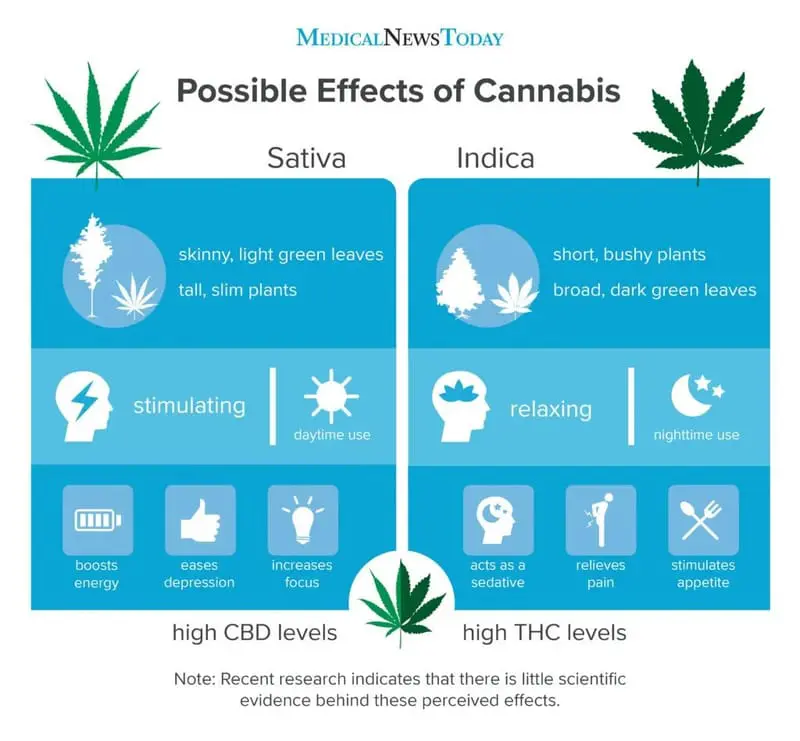
Indica-dominant strains are brusque plants with broad, dark green leaves. On the other hand Sativa-ascendant strains are typically taller and take thin leaves with a stake green colour. If y'all'd like a visual representation, yous tin check out the diagram below.
Chemical Differences
The concrete difference isn't the only thing that separates the ii subspecies. They are too chemically different. The written report mentioned that Indica-dominant strains have a higher concentration of cannabidiol (CBD) while Sativa-dominant strains tend to have more THC. Needless to say only the Sativa strains are the preferred strain for getting loftier. Due to these chemical differences, Sativa and Indica give users a different feeling every bit you tin discover from the diagram above.
What is the Endocannabinoid System?
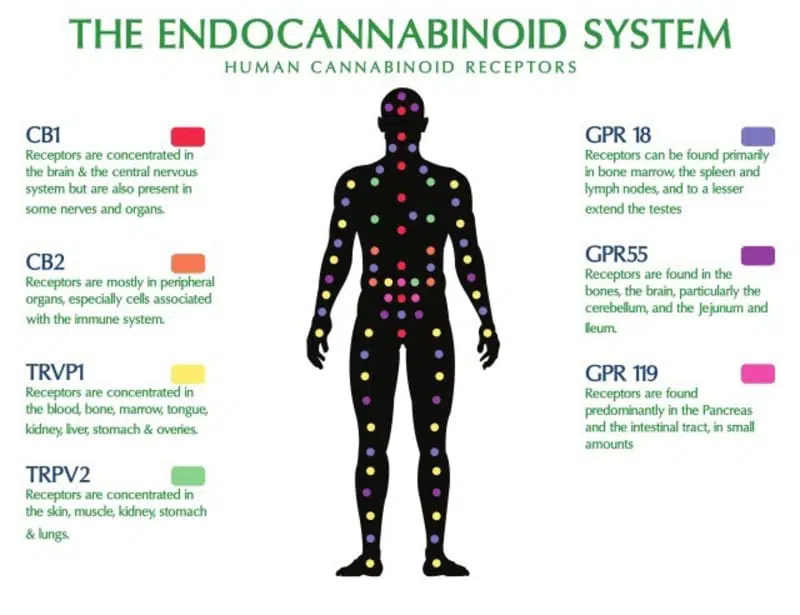
The human body has its very own endocannabinoid system. According to Healthline, the endocannabinoid organization is a complex jail cell signalling system that has iii main components: endocannabinoids, receptors, and enzymes. You lot can examine the receptors and where they are located in the body in the diagram below.
What is interesting about this organisation is that information technology was really discovered in the 1990s while scientists were studying THC. Since it's recently discovered, information technology's non sure how it all works. The endocannabinoid system is primarily responsible for maintaining homeostasis (maintaining the stability of the body'south internal environment).
What does the Endocannabinoid System Practice?
Co-ordinate to Healthline, researchers have linked the endocannabinoid system to the following:
- appetite and digestion
- metabolism
- chronic pain
- inflammation and other immune arrangement responses
- mood
- learning and memory
- motor command
- sleep
- cardiovascular system function
- muscle germination
- bone remodeling and growth
- liver function
- reproductive arrangement function
- stress
- skin and nerve function
The Endocannabinoid Arrangement Basics
Healthline says your trunk makes its own endocannabinoids, namely anandamide (AEA) and 2-arachidonoylglyerol (2-AG) which binds to your receptors and do their jobs. They can either demark to CB1 receptors, which are by and large found in your central nervous system or CB2 receptors, which are primarily found in your peripheral nervous system. When it'south time for the endocannabinoids to exist broken down past enzymes, fat acid amide hydrolase breaks downwards AEA and 2-AG is broken down by monoacylglycerol acrid lipase.
So you may exist wondering what does this have to do with cannabis? Cannabinoids from marijuana besides bind to your receptors when consumed.
Chemical Makeup of THC (Tetrahydrocannabinol)
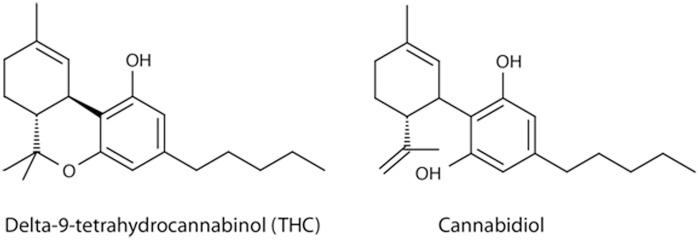
THC, an effluvious terpenoid is one of the master components of marijuana and information technology'due south almost popularly known for making yous feel high. Information technology'southward a lipid compound that may be used by the marijuana plant for defence force confronting things similar insects and UV light. THC occurs mainly as tetrahydrocannabinolic acid (THCA, 2-COOH-THC, THC-COOH). THCA, when heated, such equally when smoking, becomes THC due to decarboxylation.

According to Healthline, THC has 21 carbon atoms, 30 hydrogen atoms, and ii oxygen atoms (simply like CBD). THC binds to both the CB1 and CB2 receptors in your body. You lot may feel euphoric or high because of THC bounden to CB1. You may experience hungry, paranoid, anxious or reduction in pain when using marijuana, it's all due to the THC bounden to your cannabinoid receptors.
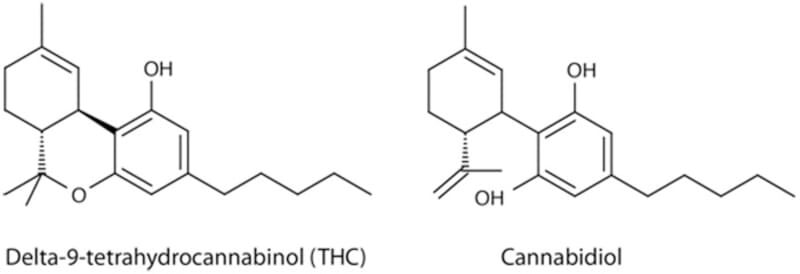
THC also occurs in two forms, Delta-8-tetrahydrocannabinol and delta-9-tetrahydrocannabinol. According to Cancer.gov, even though delta-8-THC binds to receptor CB1, "lower psychotropic potency" than delta-9-THC.
Chemic Makeup of CBD (Cannabidiol)
A study stated that CBD is the main non-psychotropic compound in the Cannabis sativa plant and it accounts for 40% of the excerpt. According to Healthline, CBD too has 21 carbon atoms, 30 hydrogen atoms, and 2 oxygen atoms.
CBD is present due to non‐enzymatic decarboxylation of cannabidiolic acid (CBDA). Y'all can take a look at the process in the diagram below:
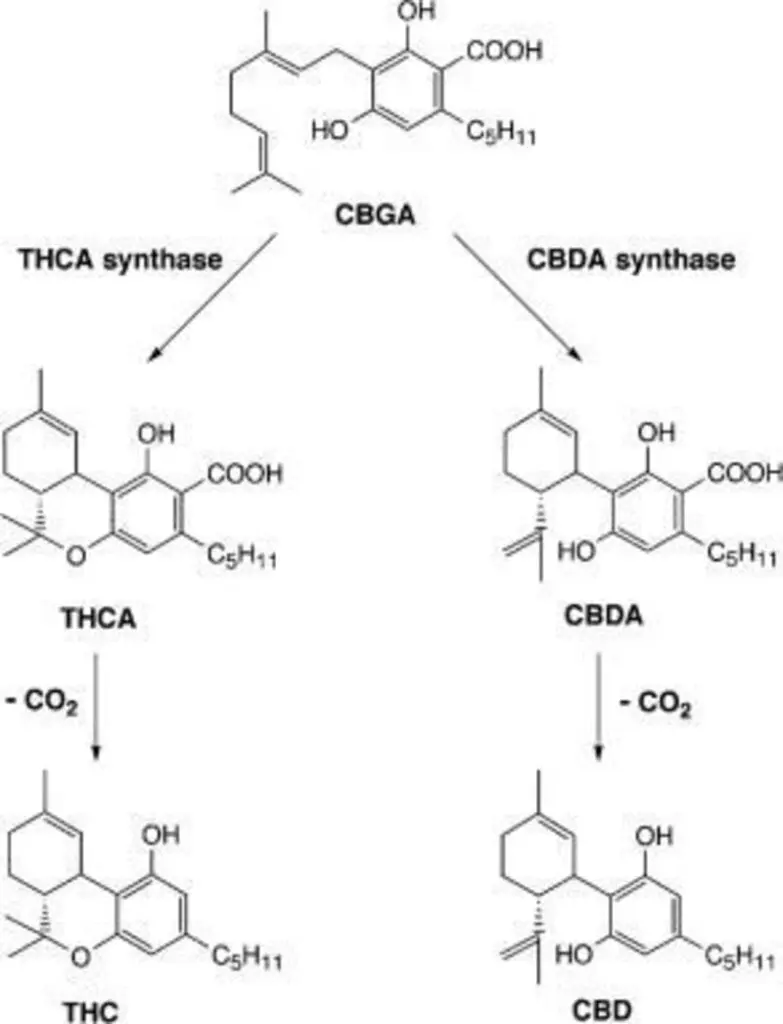
CBD is non responsible for the high feeling, it can exist sort of an antagonist to THC. According to Healthline, "CBD binds very weakly, if at all, to CB1 receptors", the article went on to say that CBD needs THC to bind to the CB1 receptor and so it can counteract some of the psychoactive effects of THC.
In that location is nevertheless some mystery surrounding just how CBD binds, Healthline reports, "Experts aren't completely sure how CBD interacts with the ECS. But they do know that it doesn't bind to CB1 or CB2 receptors the mode THC does.". They believe that CBD may forestall the disintegration of endocannabinoids or information technology may merely demark to a receptor that hasn't been discovered yet.
Conclusion
While there is still a lot of marijuana research needed, scientists are well on their way to figuring out the chemical makeup of marijuana. The use of cannabis is definitely not new but understanding it from a chemic and molecular level is much newer. You probably won't think all the scientific details when consuming weed. However, whenever you're curious as to what is going on where chemistry is concerned, experience free to come back and read this article.
Do you lot take more burning questions effectually cannabis?
E-mail us at [email protected] with your questions/topic suggestions and we will become dorsum to you lot!
Source: https://stonersrotation.com/news/what-is-marijuana-cannabis-chemistry-101
Posted by: neelypappok.blogspot.com
0 Response to "What Is A Description Of A Tylenol Chemical Makeup"
Post a Comment